Showing posts with label Japan. Show all posts

Wednesday, October 22, 2014

Mata ne, Japan.

We had narrowed it down to two choices: Camp Lejuene, NC or Japan. For me, it was not a tough decision. I desperately wanted to see more of the world, and I knew that I’d probably never travel to Japan on my own. I was ecstatic when we got orders to Yokosuka, and I started doing everything I could to prepare myself for our move.

Because I was so excited about moving to Japan, I was completely surprised by the culture shock when it hit me. I knew that I would have some trouble adjusting to a new place, and an unknown language, but those first six months were really hard. I doubted whether or not I should have moved.

But then, Japan wooed me. I could not help but fall in love with its mountains that so comfortingly reminded me of East Tennessee. I fell in love with its kind and proud people, always willing to help a confused-looking foreigner who is obviously lost. I loved the food – especially katsudon, a Japanese comfort food of fried meat on top of steaming rice cooked with green onions and egg. I loved the wonderful mix of old and new: modern houses with all the usual amenities, but with intergenerational families living in them, sleeping on tatami mats with futons every evening; ancient temples in the middle of bustling modern cities; young girls talking on their cell phones while wearing kimonos. I adored the ancient history of the country, which was in stark contrast to the young America I grew up in.

Most of all, I loved visiting the temples. Oh, the temples. There is nothing quite like walking up to the front gate of an ancient Zen Buddhist temple, and stepping over the large beam of wood, hundreds of years old, which divides the ordinary from the sacred. Temple grounds enchant me. It’s as though I can feel the history seeping out of the earth. I felt the same way in the Notre Dame Cathedral in Paris, France. I was listening to mass in this large, looming cathedral, and I took my shoes off so that I could feel the cold stone floor beneath me. I knew that countless others had walked on those floors before me, all connected by a belief in something larger than themselves. The temples of Japan evoke the same feeling in my soul.

 One of the most meaningful experiences I’ve had in Japan has been taking part in zazen, or Zen Buddhism’s sitting meditation. I still remember how giddy I was to go to my first zazen session at Kenchoji temple in Kamakura. I could not believe that after studying Eastern religions in college, I was now walking into an ancient Buddhist temple in Japan to sit with monks and meditate. I fell in love with the scent of incense wafting through the temple; the faint aroma of aged wood. I loved the way my bare feet felt against the woven tatami mats on the floor, and the feel of the cushion underneath me as we sat and bowed to each other before beginning zazen. I became completely addicted to the calm of the room as these human beings came together to quiet their minds, taking what was probably the only moment in their day to be still, listen, and feel the world around them.

I never dreamed that I’d be friends with Buddhist priests, or that I’d fall in love with the practice of zazen (who ever thought I’d be able to sit still, and in silence, for almost an hour?!).  I never dreamed that a foreign country in Asia would become another place I called home. And I never knew that I’d fall so deeply in love with Japan that it hurt my heart to leave.

 I went to visit Dokuonji temple, the temple of my friend Fujio san, on Tuesday night before flying out of Japan the next day. I could barely get out of the car when I arrived. I knew that it would be the last time, in the foreseeable future, that I’d step into that temple. Over the course of the last two years, Dokuonji temple became MY temple. It’s been years since I felt comfortable in a church, and this temple became my church. It became the place where I could go and feel closer to God. Each visit had me leaving with a wonderful stirring in my soul.

On that last night, I talked with Fujio san, and could barely hold back the tears. Fujio san was no better. We talked about how much we have enjoyed each other’s friendship, and how much the temple had meant to me. We talked about my divorce, and he lovingly told me that he would always support me, and that I had no need to blame myself, or my husband, for what was happening. We then sat in zazen together for a while, me wiping back tears as we began. Just as it was supposed to, zazen calmed my feelings of grief and anxiety, dulling them just enough to make them more manageable. I felt immense gratitude as I sat there in the darkness, listening to crickets outside, and smelling the incense stick that I’d lit upon my arrival. These experiences are what life is about.

My life in Japan was a blessing. Even knowing what I know now about my marriage and what was to come, I would not have done anything differently. I needed Japan. I needed to grow in my spiritual practice, to challenge myself in ways that made me feel vulnerable, and to expand the world for my children and myself.


Thank you, Japan. I love you and will miss you terribly. You will always have a piece of my heart.

Friday, June 13, 2014

Hakone Open-Air Museum (with my sister!)

While my sister was visiting last month, I knew that one place she had to visit was Hakone. Up in the mountains, close to Mt. Fuji, with gorgeous views and lush greenery, Hakone was right up her alley. I've been to the Hakone shrine before, but another place in Hakone high on my list was the Hakone Open-Air Museum. 


Here are the specifics for the museum:
Open 9:00am-5:00pm. 
Parking is only 500 yen ($5 US)/day.
Adults: 1,600 yen
University and high school students: 1,200 yen
Elementary and middle students: 800 yen
There are two restaurants and two cafes, but you're also welcome to bring your own food.

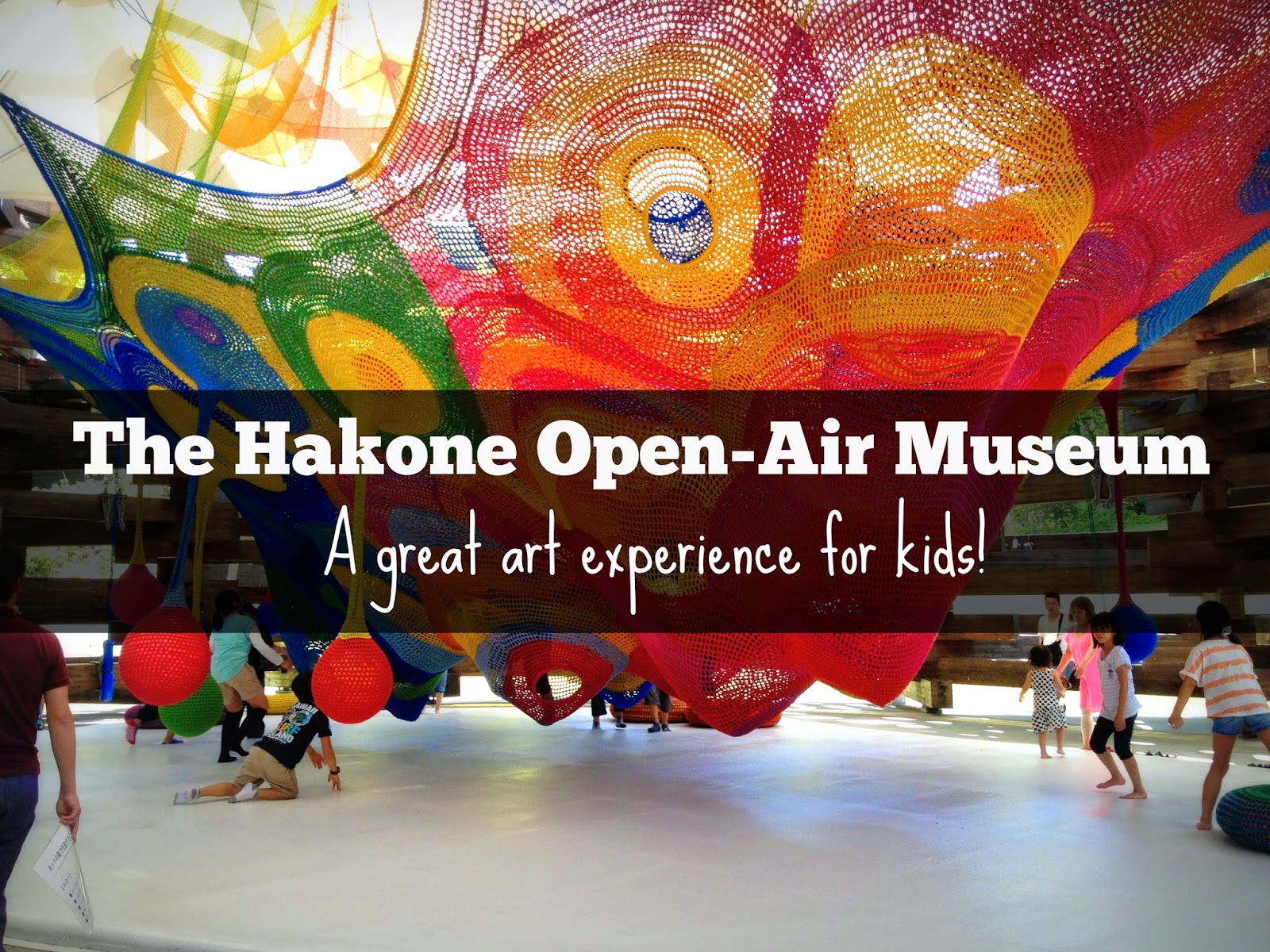
If you have children, you might think they won't be too interested in an art museum... but this is no ordinary art museum. Hakone's Open-Air Museum has plenty of artwork that you can't touch, but it also has several areas dedicated specifically to children and their exploration of art. That's right - this art museum has art that is made to be played upon. Two areas are outdoors, but there is also an indoor area as well (we didn't go in because of time constraints). My girls had a blast, and my sister and I just laid in the grass and enjoyed the mountain air while the girls tired themselves out. It was the best visit we've ever had to an art museum.


The first play area we came upon. Only children were allowed to climb on the art, and I was jealous!


That's my kid tangled up in there.


She's not so sure about climbing up this high.... 

There were lots of tears coming down these stairs. The girls did not like the height.

Me and my sister. :)
There is also a free footpath that we had to try out. It felt great.


Most days, I feel just like this guy.

This was our favorite play area. It was like a big maze of plastic bubbles.
**My girls loved this area, but my 4.5 year old had trouble at times climbing through it. It would be almost impossible for younger children to climb, though they'd probably have a good time anyway. Climbing did become a lot easier when we let them take off their socks and shoes.**


I love this shot!
This museum was GREAT, and the drive to get there was beautiful. It might be too hot for kids in the summer, but it would be a fantastic place to go in the spring and fall. I have a feeling we'll be taking a second trip there before we know it.

Wednesday, June 4, 2014

Bathing with strangers - a surprisingly nice Japanese tradition. (A guide to Enospa and onsen etiquette.)

It's been almost a month ago since I bathed with strangers at EnoSpa, but we've had so many visitors and have been so busy that I'm just now getting a chance to write about it.


One of the things everyone says you should do when you visit Japan is to go to a Japanese onsen. An onsen is a spa/inn/bathing facility with a natural hot spring. Onsens in Japan date back to Ancient times, as onsens were believed to have healing powers, and the arrival of Buddhism in 552 AD supported the use of onsens as a way to remain purified.

To the average Westerner, the idea of going to an onsen and bathing nude with complete strangers is shocking.
Western, Christian-influenced views of nudity – and its relation with sex – are at odds with the Japanese take on nakedness, which finds nothing intrinsically suggestive, offensive or debauched about public bathing in the buff. When Francis Xavier inaugurated the first Christian mission to Japan in 1549, the missionaries who arrived were horrified to learn of the Japanese custom of almost daily public bathing, often with men and women sharing the same tub. Their disgust was exacerbated, too, by the fact that many sixteenth century Europeans believed daily bathing to be harmful to one’s health. (www.Japanzine.com)
I know several Americans who have tried onsens while here, and all of them said it was a great Japanese experience. I had made up my mind to give it a try, but I had yet to go with my husband because we'd have to go to separate bathing areas. (There are mixed-bathing facilities where you are required to wear a swimsuit, but it's not quite the same experience as the traditional onsen.) The last thing I wanted to do was try to figure out proper onsen etiquette on my own. So, I was thrilled when our friends came to visit in April and said they wanted to try it out.

We decided to go to Enospa on Enoshima Island - about a 20 minute drive from our house. If you'd like to go to an onsen, and would specifically like to visit EnoSpa, here's your guide (with photos taken straight out of the English brochure):

Getting to Enospa:


What to do when you get there:


When you go to the admission counter, you'll get a locker key. This key will be attached to you/your party and will be used for a locker, and to pay for any services. For instance, when you put on a robe before/after your soak and go get a massage or eat in one of the restaurants, the attendant/waitress will charge the service to your key number. Then, when you leave Enospa, you'll take your key back to the front counter and you'll be charged for whatever services you used.

You'll also be given a mesh bag with 2 towels (one large, one small) and a robe.

The baths:


There are co-ed and gender-separated baths. Bring your swimsuit so that after you soak in the women/men-only baths, you can go down to the other indoor/outdoor pools. If you go during the day, you might have a great view of Fuji. We went in the evening and though we didn't see Fuji san, it was wonderful to soak in a hot bath with the ocean waves just beneath us.

Onsen etiquette:

When you walk into the women's/men's area, find a locker and undress. Wrap yourself in the large towel and carry the small one with you to the onsen door. There are two doors leading to the onsen. Inside the first door are cubbies where you take off your large towel and store it until you come back out of the bath. On the wall behind you is a large board with suggested ways to bathe (when to wash yourself off, suggested orders of baths, how long to stay in, etc.). After you have removed your large towel, take your smaller one and walk through the second door into the bathing area. There will be small shower stalls along the inside wall. Sit down at one of these stalls, on the small stool provided. On the shelf in front of you will be shampoo, conditioner, and body wash - all provided by the spa. Wash yourself really well before getting into the bath. When you're ready to get in, place the small towel on your head (or wrap your hair with it) and enjoy your soak.

My favorite bath was the carbonated bath! It felt so good to have tingly little bubbles all over your skin. When you're done with bathing, wash again before leaving the room. If you are concerned about doing things the right way, just pay attention to what all the Japanese are doing and copy them.

Go back out to the cubby area and wrap up in the large towel before exiting. After we left the nude onsen, we put on our swimsuits and robes and met our husbands for dinner upstairs. (Don't do what we did and completely miss the small row of slippers just inside the restaurant door.) After dinner, we all went down to the co-ed pools for another soak. And surprisingly, we opted for a second soak in the nude onsens before leaving for the night. I would not mind a soak in the onsen every weekend!

I have to say, as nervous as I was about bathing in the nude with a bunch of strangers... it turned out to be wonderful. It was amazingly relaxing, and to be honest, it was nice to be around a bunch of normal bodies - bodies not photo-shopped and all exactly alike - with absolutely no cares in the world about the fact that we were all naked. It is so different from American culture and ideas about nudity - and it was refreshing.

Other things to do at Enospa:


Hours and prices of Enospa:

Hours vary slightly depending on the season, but the average hours are 10:00am-10:00pm with last admittance at 9:00pm. Also, if you go after 7:00pm, you'll get a discounted price.

Full-day price is 2,742 yen (about $27 US) and night-spa price is 1,705 yen.


If you have ever considered going to an onsen... YOU NEED TO GO! It's a great experience and you'll be very glad you did. 

Have any questions about a visit to an onsen? Let me know and I'll try to answer them.

Monday, February 3, 2014

Yokohama Chinatown


We've been using The Story of the World for a general "world study" curriculum that encompasses history, geography, culture, and social studies. One of the areas we studied that my girls had a particularly enthusiastic interest in was Ancient China. So when we were looking for something to do on a free Sunday, we thought the girls would be excited to visit Yokohama's Chinatown during the Chinese New Year celebrations.

Yokohama is an easy and quick trip from our house (especially compared with Tokyo), taking roughly half an hour and only 1-2 train transfers. Yokohama's Chinatown was established in the mid-1800's because Yokohama's port opened to foreign trade. Many Chinese traders settled in the area, and today, Yokohama's Chinatown is not only the largest Chinatown in Japan, but in all of Asia. The area is one of the most popular tourist areas in Japan, largely due to the amazing selection of food. There are over 200 restaurants within the few blocks making up Chinatown, as well as many food carts and stands where you can sample foods from nearly all regions of China.


We got into Chinatown around noon, so our first order of business was picking a restaurant for lunch. Unfortunately, everyone else in Chinatown had the same plan and most restaurants were covered up! We almost stopped at one, but the woman outside ushering people in and passing out menus showed us that it was an all-you-can-eat buffet. And considering it was going to be a miracle if our kids ate anything, we opted not to spend the money on a buffet. So we finally just stepped into a random restaurant that didn't look too crowded, and had some nice plastic food sitting in the window.

We were seated, and handed menus, and were a tad bit disappointed to find absolutely no English inside the menu. You can't always expect to find English wherever you go, but many restaurants - especially in tourist areas - will often have English on the menu. No such luck here. So we reverted to looking at pictures and trying to pick something that looked good. There were several sets (meals with several plates) in the front of the menu, so we decided on one that looked like it would have plenty for all four of us to split. It was roughly $32.

We motioned to our waitress that we were ready, and we pointed to the set and then tried to explain that we'd all like to share. She started speaking quickly in Japanese (too quick for my poor brain to translate) and when she realized I probably didn't understand her, she took out a pen and paper. She wrote down the price, and then wrote "x2" beside it. I looked at The Hubs with a look that I'm sure expressed my concern.... The waitress must have noticed my confusion/hesitation, and she pointed to another set and wrote the price x2. Ohhhhh.... the prices are per person. And we couldn't split it up.

So we reluctantly ordered two $32 sets, because it seemed like the set most likely to appease our children, and because we really weren't sure we had any other choice.


While my children might look happy in the pictures above, lunch was a bit of a struggle. They brought out one plate at a time, which was great, but everything was so freshly made (again, not necessarily a bad thing) that it was BURNING hot. More than once, one of the girls was in tears because her mouth/lips/tongue had been burnt. And while they gave almost everything a good try, they only liked 1-2 items. Oh, and in the middle of lunch, The Hubs started getting calls from work about a patient and had to step out to answer them. Thankfully, the last items in our set were two bowls of a fruity dessert, and the girls were thrilled to finally have something they really wanted to eat. Do I think the meal was worth the $63.00 we paid? Probably not. But it was definitely another experience to log in our books, and we got to try some new food.

After lunch, we went in search of one of the Chinese temples located in Chinatown. We had no idea where we were going, but when you see a bunch of ornate dragons and gold on the roof of a building, you're pretty sure you're headed in the right direction. That's exactly how we found the temple.


Unfortunately, by the time we got to the front of the temple, The Hubs wasn't feeling so well. He was the last in our family to be attacked by "The Sinus Infection from Hell," and he wasn't quite over it yet. Add that to the interesting dishes we had just eaten for lunch and he was looking pretty rough. The girls wanted to go in the temple, but it was so crowded - and their Daddy was feeling so bad - that we decided to just take a couple of pictures out front before heading back home.


We did stop in a couple of souvenir shops on the way out, and the girls loved all the ornate jewelry, golden Chinese dragons, and fat, happy Buddhas. There is also another, larger, temple in Chinatown and I think we'll probably try to make another trip at some point to walk around a bit more. I'm not sure we'll be eating in Chinatown next time... or if we do, we'll be snacking on food from the carts and stands. At least the girls had a good time experiencing a little piece of China. I think a trip to the real China might be in order before we move back to the states....

Thursday, December 26, 2013

Miyajima Island


On our second day in Hiroshima, we traveled to Miyajima Island, home of Itsukushima shrine, Mount Misen, Momijidani Park, and numerous shrines and temples. This island is supposedly the home of one of the three best views in all of Japan. To get there, we had to take a 30-40 minute ride on the streetcars, and then a 5-10 minute ferry ride out to the island. 

The island of Miyajima has been considered a holy place for most of Japanese history. Mount Misen was established as a holy Buddhist site in 806 - yes, YEAR EIGHT-HUNDRED AND SIX - and it has long been preserved as a special part Japanese history and nature. 


We bumped into some Samurai on the way.


The first thing we did when we set foot upon the island was to head over to Itsukushima shrine, another UNESCO World Heritage site. "The shrine has been destroyed many times, but the first shrine buildings were probably erected in the 6th century. The present shrine dates from the mid-16th century, and is believed to follow an earlier design from the 12th century. That design was established in 1168, when funds were provided by the warlord Taira no Kiyomori" (Wikipedia). The shrine was built on stilts above the water so that ordinary people could visit the island without "defiling" the island with their footprints upon its land.

One of the defining images of Miyajima island is the torii gate out in the water, separating the ordinary world from the sacred space of Istukushima shrine. Oh, and you'll also find deer wandering the island of Miyajima. They are used to people... a little too used to people... so you need to be careful if you're walking around with any food in your hands, pockets, or bags.


The famous torii in the water.


The purifying fountain at the entrance to Itsukushima. My girls know just what to do.

Walking into the shrine.


Some sort of blessing ceremony going on inside.


After leaving the shrine, we headed up to Miyajima's Five-Story Pagoda. It was built in 1407 with Chinese techniques brought over with Zen Buddhism. It is a bright orange color and impossible to miss.


For lunch, we stopped at a stand for yakitori (chicken on a stick), as well as beef, pork, corn, and french fries. It was DELICIOUS. After eating (and protecting our food from the deer), we followed signs for Mt. Misen and the ropeway. Now, you could walk the whole way up to the top of Mt. Misen if you wanted to... but if you bought a 1- or 2-day pass, the ropeway is included and is definitely the way to go.

Love the "if you run a little" part. 


Pops said the only way we got him to ride on this thing was because the grandkids wanted him to.

Great views of the primeval forest.


There are two parts to the ropeway, and once you get to the end of of it, there's about 30 more minutes of hiking to the observation tower at the highest point on the island. It was a lot higher than I thought it was. We did not go up to the observation tower because it was pretty cold, and our kids were getting tired of walking. However, we still had some fantastic views from the spots we made it to.

After coming back down the ropeway, we started making our way back to the ferries. On the way back, we walked through Omotesando - the popular shopping street in Miyajima. One of the first shops we stopped in was making Miyajima's famous Momiji Manju, a maple leaf-shaped waffle with various fillings. Not a personal favorite of my own, but my kids liked them.


Miyajima was beautiful, and it was a great day trip during our stay in Hiroshima. I can only imagine what the forest would look like in spring or fall. And after all that hiking and walking on the island, I think we had some of the best sleep we'd had in weeks.