Showing posts with label Hiroshima. Show all posts

Sunday, December 29, 2013

Our Visit to Hiroshima Castle


On our last day in Hiroshima, we had a few hours to kill between check-out time at our hotel and our departure on the bullet train. Our 2-day streetcar passes had also expired, so we wanted to find something to see within walking distance. Luckily for us, Hiroshima Castle was only a few blocks away.

The original Hiroshima Castle was built in the 1590's, and there was no Hiroshima city at the time. After the establishment of the castle, a town grew around the castle and 70% of the residences belonged to samurai families. After the abolishment of the feudal system (samurai rule), the castle grounds were used as military facilities, and the Imperial Military Headquarters during the First Sino-Japanese War in 1894-1895. The castle was destroyed by the atomic bomb in 1945, and a concrete replica of the castle was built on the original foundation in 1958. This replica now houses a samurai museum. You'll also find a shrine within the castle grounds, built after 1945, called Hiroshima Gokoku Jinja.

My kids were very excited to see a real castle, complete with a moat.  The moat and foundational walls were pretty impressive when you thought about how long ago they'd been built. My children are also fascinated with samurai, so they were thrilled to know that samurai had once lived there.

We weren't allowed to take pictures throughout much of the castle museum, but I think kids and adults would enjoy visiting. It's around $3.00 (or 300 yen) for adult admission, and young children (under 6) are free. You can also walk around outside the top tier of the castle, giving you a pretty good view of Hiroshima. I was able to spot the A-Bomb Dome from up there which helped to put in perspective the distance the castle had been from the epicenter of the blast. No wonder it was completely destroyed... it wasn't very far away at all.


This a model of the town of Hiroshima hundreds of years ago, with the castle grounds in the center.

The walkway around the top of the castle.

View of the castle grounds and Hiroshima city.

If you zoom in, you can see the A-Bomb Dome not too far away. 

Hiroshima Castle was a great site to visit, and only a 25 minute, leisurely walk (we had small kids!) from Hiroshima Station and Hotel Granvia. We were in and out of the castle museum and grounds within 1-2 hours. And if you have kids, they will be sure to love visiting a real castle.

Thursday, December 26, 2013

Miyajima Island


On our second day in Hiroshima, we traveled to Miyajima Island, home of Itsukushima shrine, Mount Misen, Momijidani Park, and numerous shrines and temples. This island is supposedly the home of one of the three best views in all of Japan. To get there, we had to take a 30-40 minute ride on the streetcars, and then a 5-10 minute ferry ride out to the island. 

The island of Miyajima has been considered a holy place for most of Japanese history. Mount Misen was established as a holy Buddhist site in 806 - yes, YEAR EIGHT-HUNDRED AND SIX - and it has long been preserved as a special part Japanese history and nature. 


We bumped into some Samurai on the way.


The first thing we did when we set foot upon the island was to head over to Itsukushima shrine, another UNESCO World Heritage site. "The shrine has been destroyed many times, but the first shrine buildings were probably erected in the 6th century. The present shrine dates from the mid-16th century, and is believed to follow an earlier design from the 12th century. That design was established in 1168, when funds were provided by the warlord Taira no Kiyomori" (Wikipedia). The shrine was built on stilts above the water so that ordinary people could visit the island without "defiling" the island with their footprints upon its land.

One of the defining images of Miyajima island is the torii gate out in the water, separating the ordinary world from the sacred space of Istukushima shrine. Oh, and you'll also find deer wandering the island of Miyajima. They are used to people... a little too used to people... so you need to be careful if you're walking around with any food in your hands, pockets, or bags.


The famous torii in the water.


The purifying fountain at the entrance to Itsukushima. My girls know just what to do.

Walking into the shrine.


Some sort of blessing ceremony going on inside.


After leaving the shrine, we headed up to Miyajima's Five-Story Pagoda. It was built in 1407 with Chinese techniques brought over with Zen Buddhism. It is a bright orange color and impossible to miss.


For lunch, we stopped at a stand for yakitori (chicken on a stick), as well as beef, pork, corn, and french fries. It was DELICIOUS. After eating (and protecting our food from the deer), we followed signs for Mt. Misen and the ropeway. Now, you could walk the whole way up to the top of Mt. Misen if you wanted to... but if you bought a 1- or 2-day pass, the ropeway is included and is definitely the way to go.

Love the "if you run a little" part. 


Pops said the only way we got him to ride on this thing was because the grandkids wanted him to.

Great views of the primeval forest.


There are two parts to the ropeway, and once you get to the end of of it, there's about 30 more minutes of hiking to the observation tower at the highest point on the island. It was a lot higher than I thought it was. We did not go up to the observation tower because it was pretty cold, and our kids were getting tired of walking. However, we still had some fantastic views from the spots we made it to.

After coming back down the ropeway, we started making our way back to the ferries. On the way back, we walked through Omotesando - the popular shopping street in Miyajima. One of the first shops we stopped in was making Miyajima's famous Momiji Manju, a maple leaf-shaped waffle with various fillings. Not a personal favorite of my own, but my kids liked them.


Miyajima was beautiful, and it was a great day trip during our stay in Hiroshima. I can only imagine what the forest would look like in spring or fall. And after all that hiking and walking on the island, I think we had some of the best sleep we'd had in weeks.

Hiroshima's Peace Park


On our first afternoon in Hiroshima, we decided to visit the Hiroshima Peace Park. Within the park, you'll find the A-Bomb Dome, the Peace Memorial Museum, the Children's Peace Monument, the Flame of Peace, and the Cenotaph for bomb victims. 

A few weeks ago, I showed my children a video on Hiroshima from BrainPop, so my oldest daughter was very excited about seeing the A-Bomb Dome in person. We took the streetcars from our hotel to the Genbaku Dome-mae (A-Bomb Dome) stop. As we started walking over to the Dome, my oldest started yelling, "I see it! I see it! And it's even bigger than I imagined it would be!" I love seeing my children become excited about history.


The Dome is a UNESCO World Hertiage site, and is considered a symbol of Hiroshima. On August 6th, 1945, the building was severely damaged and burnt by the the first atomic bomb ever used in warfare. The building had a lot more to it than you'll see today, but since the dome was in the center of the building, it managed to survive the blast. It was crazy to think that only 68 years ago, the place where we were standing had been leveled. The heaviness in your body was unavoidable when you thought of the horror that had taken place in that very spot.

We walked across a bridge to the main area of the park. In front of us was the Children's Peace Monument, based on the story of Sasaki Sadako, a junior high girl who died of luekemia, caused by the bombing 10 years after it happened. She believed that if she folded 1,000 paper cranes, she would get well. Today, people from all over the world fold paper cranes to be sent to this monument in Hiroshima.


We then walked to the Peace Flame, another monument dedicated to the victims of the bomb with an additional symbolic purpose to console the spirits of all the A-Bomb victims. The flame has been continuously burning since 1964 and will continue to burn until the world is free of nuclear weapons. 

Near the Peace Flame was the Memorial Cenotaph. It was built on August 6th in 1952. It holds the list of victims' names killed by the bomb. The cenotaph carries the epitaph, "Rest in Peace, for the error shall not be repeated." Through the middle of the cenotaph, you can see the Peace Flame and the A-Bomb Dome behind it. It's arch shape represents a shelter for the soul of the victims.


After walking through the park, we then went to the Peace Memorial Museum. I had heard that some families opted to skip this with their children (or they walked through certain parts quickly) because there were displays and exhibits that were so distressing. Our children are 5 and 4, but we wanted to take them in. I don't want to scare my children, but I also don't want to shelter them. I wholeheartedly believe that you can teach children about terrible events in history, using those events to cultivated a sense of responsibility, compassion, and determination to keep similar events from happening again. 


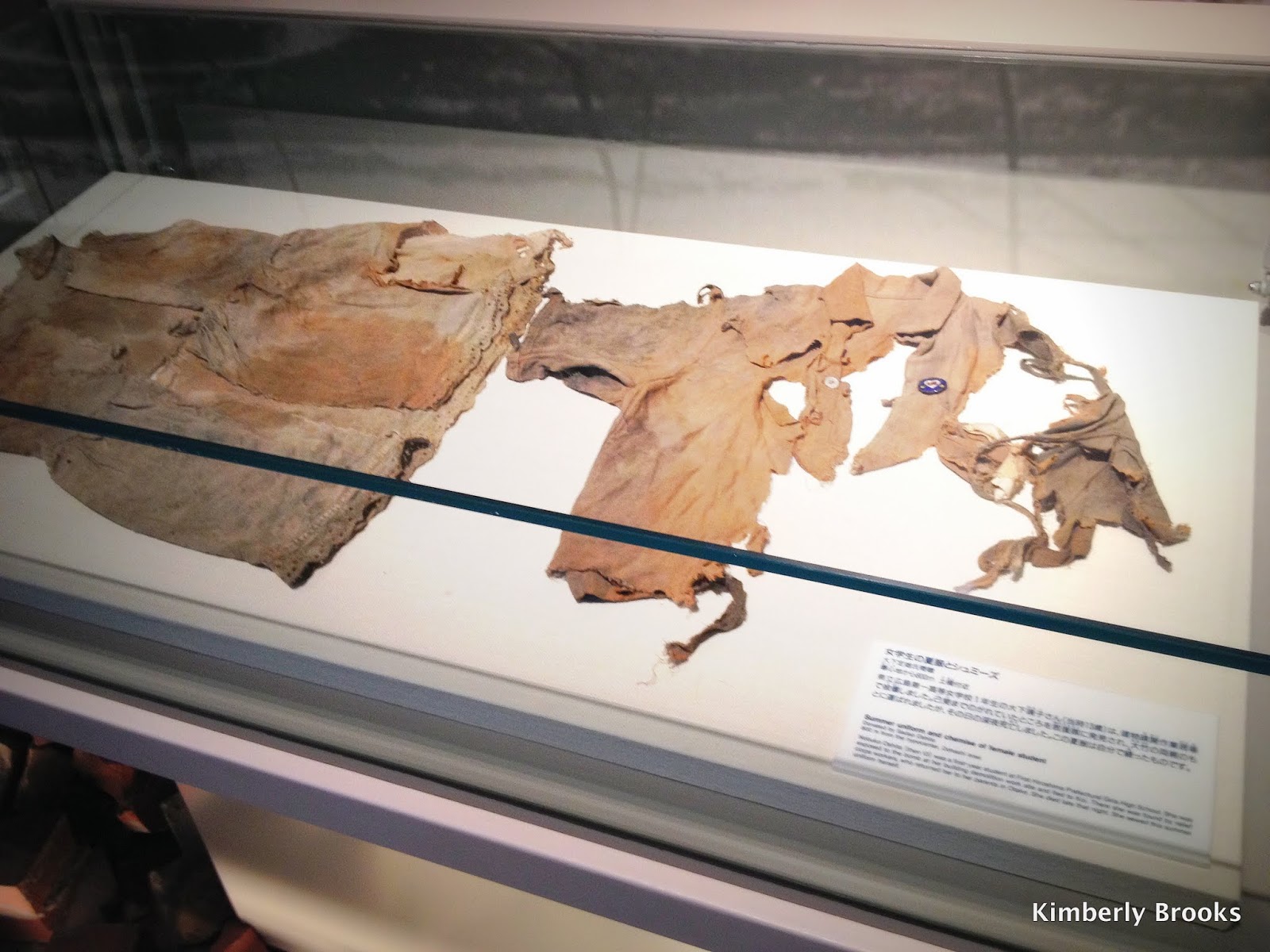
The first half the museum was about the events leading up to the bombing. It had a lot of war history, and told visitors where the bomb was dropped and what happened immediately afterwards. The second half of the museum was about the bombing victims themselves. This was the half containing pictures, artifacts destroyed in the blast, and an eerie display of victims immediately after the blast (statues with skin hanging from them). My girls asked a lot of questions and were obviously taking a lot in. They haven't said too much about it since, but I know it made a lasting impression on them. Check out the picture below of what my children did when they saw a wall covered with a picture of Hiroshima after the bombing.


Hiroshima is a place that everyone should visit if they spend time in Japan. Part of me felt a little awkward walking through the museum, knowing that it was MY country who had caused such devastation, but I never once encountered anyone in Hiroshima that was less than friendly. I wholeheartedly believe that we have a responsibility - to the victims, and to future generations - to go to Hiroshima and learn about those terrible events so that history is never repeated.